Porsche brake pads replacement: pads, discs, PCCB and costs
Posted: September 23, 2026
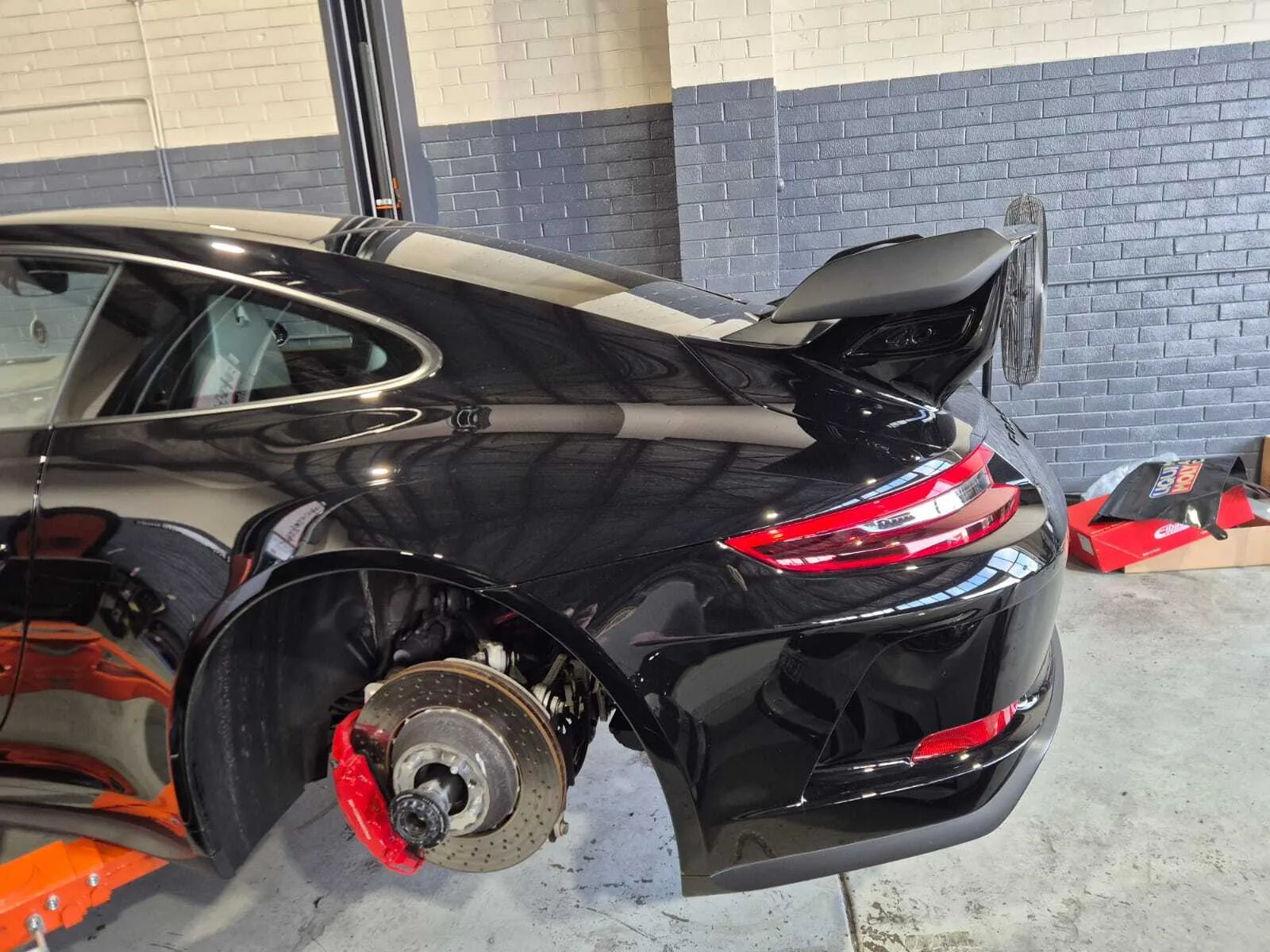
Porsche brakes are some of the best on any road car, and they are built to be used hard. That also means they wear, and parts are not cheap. If you are pricing Porsche brake pads replacement, the answer depends on which of three brake systems your car has, how you drive it, and whether the discs need doing at the same time. This guide covers pads, iron discs, coated discs, carbon ceramics, brake fluid and what Australian owners can expect to pay.
We service Porsche brakes in our Fyshwick workshop on everything from Macans to GT3s, so most of what follows comes from questions owners ask us at the counter.
How often do Porsche brake pads need replacing?
There is no fixed kilometre figure. Porsche brake pads are replaced when they reach their wear limit, which the pad wear sensors report on the dash, or when an inspection finds them close to it. A gently driven Cayenne might go a long way on a set. A 911 that does track days can wear through pads in a few events.
Porsche Australia’s own maintenance advice is that safe braking “demands replacement of brake pads at the recommended intervals, or sooner if they have reached their wear limits.” In practice, we measure pad and disc thickness at every service and tell you roughly how much is left, so the job can be planned instead of sprung on you.
Most Porsches have electrical wear sensors clipped into the pads. When the pad wears down far enough, the sensor touches the disc, the circuit breaks and the warning comes up. Once that has happened the sensor is worn too, so it gets replaced with the pads. A warning that stays on after new pads have gone in is often a sensor that was reused or a damaged wire.
Which Porsche brake system do you have?
This is the single biggest factor in what a brake job costs. Porsche uses caliper colour as a rough guide, though there are exceptions by model and year, so the build sheet or option codes are the reliable check.
| System | Disc material | Usual caliper colour | Where you find it |
|---|---|---|---|
| Standard brakes | Cast iron | Black on base models, red on many S and GT models | Most Porsches |
| PSCB (Porsche Surface Coated Brake) | Cast iron with a tungsten carbide coating | White, usually | Optional on models such as the Cayenne, Panamera and Taycan, with 20-inch or larger wheels |
| PCCB (Porsche Ceramic Composite Brake) | Carbon fibre reinforced ceramic | Yellow | Optional on most performance models |
Iron discs
Iron discs are the most common and the cheapest to replace. They wear with the pads and have a minimum thickness stamped on them. On many European performance cars, by the time the first or second set of pads is done, the discs are near that minimum or have a lip and uneven surface, so pads and discs often get replaced together. We measure before recommending it. If the discs are still within spec and running true, new pads alone are fine.
PSCB coated discs
Porsche Surface Coated Brakes use an iron disc with a hard tungsten carbide coating. The coating cuts brake dust a lot and lasts well. PSCB needs its own matched pads, and the discs cost more than plain iron. Fitting ordinary pads to PSCB discs is a mistake we would avoid.
PCCB ceramic discs
Carbon ceramic discs are light, resist fade and can last a very long time on the road. They are also expensive to replace. At the 992 911 launch in 2019, Porsche Australia’s technical representative Paul Watson told Wheels magazine that a set of replacement front-axle PCCB rotors cost about $11,500, and that the company recommends iron discs for owners doing club days, because hard track use can degrade the ceramic discs. Prices will have moved since then.
Ceramic discs are checked differently from iron ones. As well as limits stamped on the disc, the inspection looks closely at the friction surface and the edges for damage. They are also easy to chip. We take extra care lifting wheels on and off a PCCB car, because a wheel knocked against the disc edge can cost more than the service.
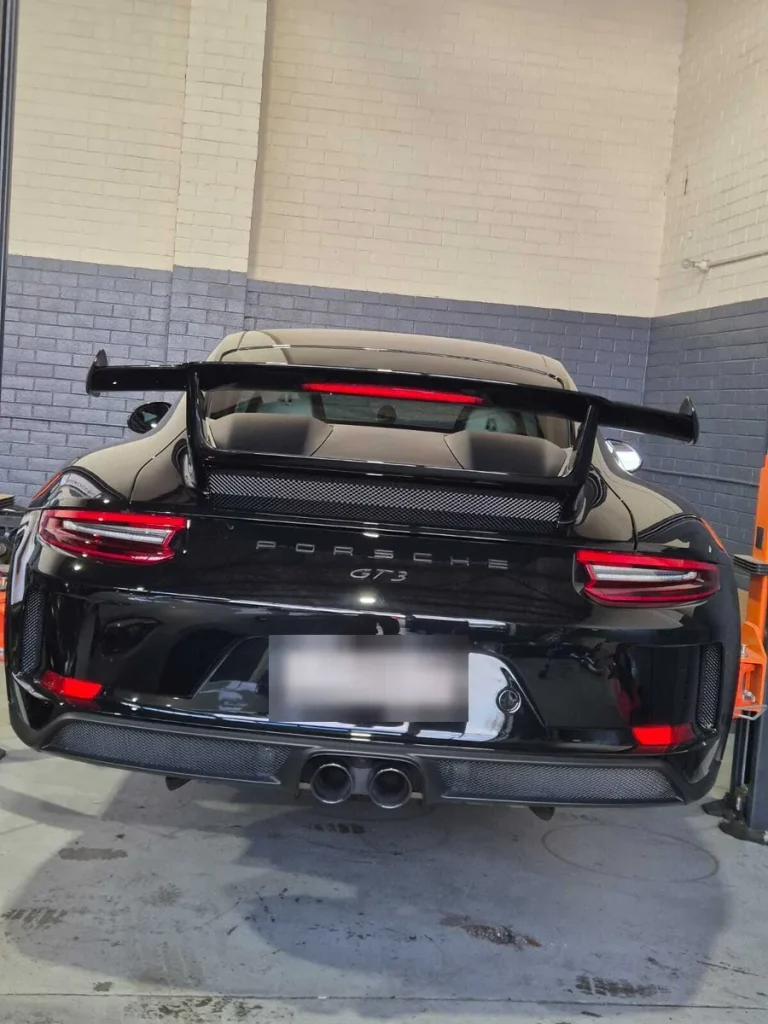
Porsche brake service cost in Australia
Porsche Centres do not tend to publish pad and disc prices, because the parts vary so much between a Macan and a 911 Turbo. The figures below give you a sense of scale. Treat them as reference points, not quotes, and expect Porsche parts to sit well above the all-makes averages.
| Job | Australian price reference | Source |
|---|---|---|
| Brake pads, any make | From $300 per axle | Yellow Pages cost guide |
| Pads and discs, any make | From $650 per axle | Yellow Pages cost guide |
| Brake fluid change, Macan | $225 to $350, every 2 years | Published Macan service pricing from Porsche Centres including Canberra, Adelaide, Melbourne and Sydney South |
| PCCB front-axle rotors (parts) | About $11,500 in 2019 | Porsche Australia, via Wheels |
The Porsche Centre brake fluid prices differ by dealer and model year. Porsche Centre Canberra’s $225 figure, for example, is for 2015 to 2018 Macans. For Porsche brake pads replacement, with or without discs, ask for an itemised quote that lists the pads, discs, wear sensors and labour separately, for each axle. That makes it easy to compare like with like.
What pushes Porsche brake service cost up: big multi-piston calipers and large discs on Turbo and GT models, PSCB or PCCB parts, new wear sensors, and discs that have to come off with the pads. A Cayenne or Macan also carries a lot more weight than a Cayman, and the pads wear to match.
How often should Porsche brake fluid be changed?
Porsche specifies a brake fluid change every two years, regardless of kilometres. Brake fluid absorbs moisture from the air over time, and water in the fluid lowers its boiling point. Under the DOT 4 standard, the minimum boiling point for fresh fluid is 230 degrees Celsius, but for “wet” fluid (fluid that has absorbed some water) it drops to 155 degrees. Brakes that get hot, such as a 911 coming down Clyde Mountain or doing laps at a track day, can boil old fluid. The pedal then goes soft at exactly the wrong moment.
If you track your car, change the fluid more often than the two-year minimum, and consider a higher-temperature fluid approved for your model. Moisture also corrodes parts inside the ABS unit and calipers, which is a much bigger bill than a fluid flush. This is one service item we would never skip to save money.
Signs your Porsche brakes need attention
- The brake pad wear warning on the dash.
- Vibration through the steering wheel or pedal when braking from speed, which often points to uneven disc wear or pad deposits.
- Grinding or scraping. That can mean the pad material is gone and metal is touching the disc. Stop driving and get it looked at.
- A soft or long pedal, which needs checking for air or old fluid.
- A visible lip on the outer edge of the disc, or deep grooves in the surface.
Some squeal from high-performance pads, especially cold and at low speed, is normal and not a fault. If it is new or getting worse, have it checked. For a wider look at brake symptoms, see our European car brake service guide.
Genuine or aftermarket Porsche brake pads?
For a road car, we fit genuine Porsche pads or pads of matching quality from the original equipment suppliers. Porsche tunes pad compound, disc and caliper as a set, and a cheap pad can change pedal feel, noise and dust, and wear the discs faster. For PSCB and PCCB systems, stick with the specified pads. Our article on why genuine parts matter on European cars goes into the reasons.
Track-focused owners sometimes want a more aggressive pad. That can make sense, but it is a trade-off: more bite when hot, often more noise and dust on the street. We are happy to talk it through, along with the other options in our Porsche performance upgrades post.
How we handle Porsche brake pads replacement
We measure the pads and discs on all four corners and check the calipers, slide pins where fitted, hoses and the wear sensor wiring. New pads go in with new sensors where needed, the hubs are cleaned so the discs sit flat, and fasteners are torqued to Porsche’s specification. Then we bed the pads in on the road, because new pads and discs need a run of moderate stops to build an even layer on the disc before they bite properly. Expect us to suggest a fluid change if it is close to the two-year mark.
Our master technician, Vijesh Otto, spent 12 years working on ultra-exotic cars in Bahrain and Dubai before coming to Canberra. You can read more on our Porsche servicing page or browse our case studies.
Frequently asked questions
How much does it cost to replace brake pads on a Porsche?
It depends on the model and brake system. As an all-makes guide, Yellow Pages lists pads from $300 per axle and pads with discs from $650 per axle, and Porsche parts usually cost more than that. Coated PSCB and ceramic PCCB systems cost considerably more again. Ask for an itemised quote per axle.
How long do Porsche brake pads last?
There is no set figure. Pad life depends on the model, its weight, the brake system and how the car is driven. A lightly used road car can go a long way on one set, while track days can wear pads out in a handful of events. The dash wear warning and measurements at each service tell you where you stand.
Do I need to replace Porsche rotors with the pads?
Not always. Iron discs only need replacing if they are below the minimum thickness stamped on them, have a heavy lip, deep grooves or run out of true. Many Porsches do need discs every first or second pad change, so a workshop should measure them and show you the numbers before recommending new ones.
How often should Porsche brake fluid be changed?
Every two years, regardless of distance, is Porsche’s schedule. Brake fluid absorbs moisture, which lowers its boiling point and corrodes internal parts. Cars that do track days should have it changed more often. Porsche Centres in Australia list Macan brake fluid changes at between $225 and $350, depending on the centre and model year.
Are Porsche ceramic brakes worth it?
For a road car, PCCB brings lower unsprung weight, less dust and long disc life. The downside is replacement cost: Porsche Australia quoted about $11,500 for front-axle rotors in 2019. Porsche Australia also said it recommends iron discs for owners who do club days, because repeated hard track use can degrade the ceramic discs.
Why is my Porsche brake warning light still on after new pads?
The most common cause is a pad wear sensor that was reused after it had already triggered. Once the sensor has worn through, it has to be replaced with the pads. A damaged sensor wire or corroded connector can also keep the warning on. A workshop can read the fault code and check the circuit to find which one it is.
If your Porsche is showing a brake warning or the fluid is due, Eurotech Canberra can check it at our Fyshwick workshop. Call us on 02 5154 7000 or book a service online.